
The following tribute to Hans Roemer was assembled for the fall winter 2026 edition of the log by Louise Beinhauer.
see the original pdf hereHans Roemer-remembrance-final
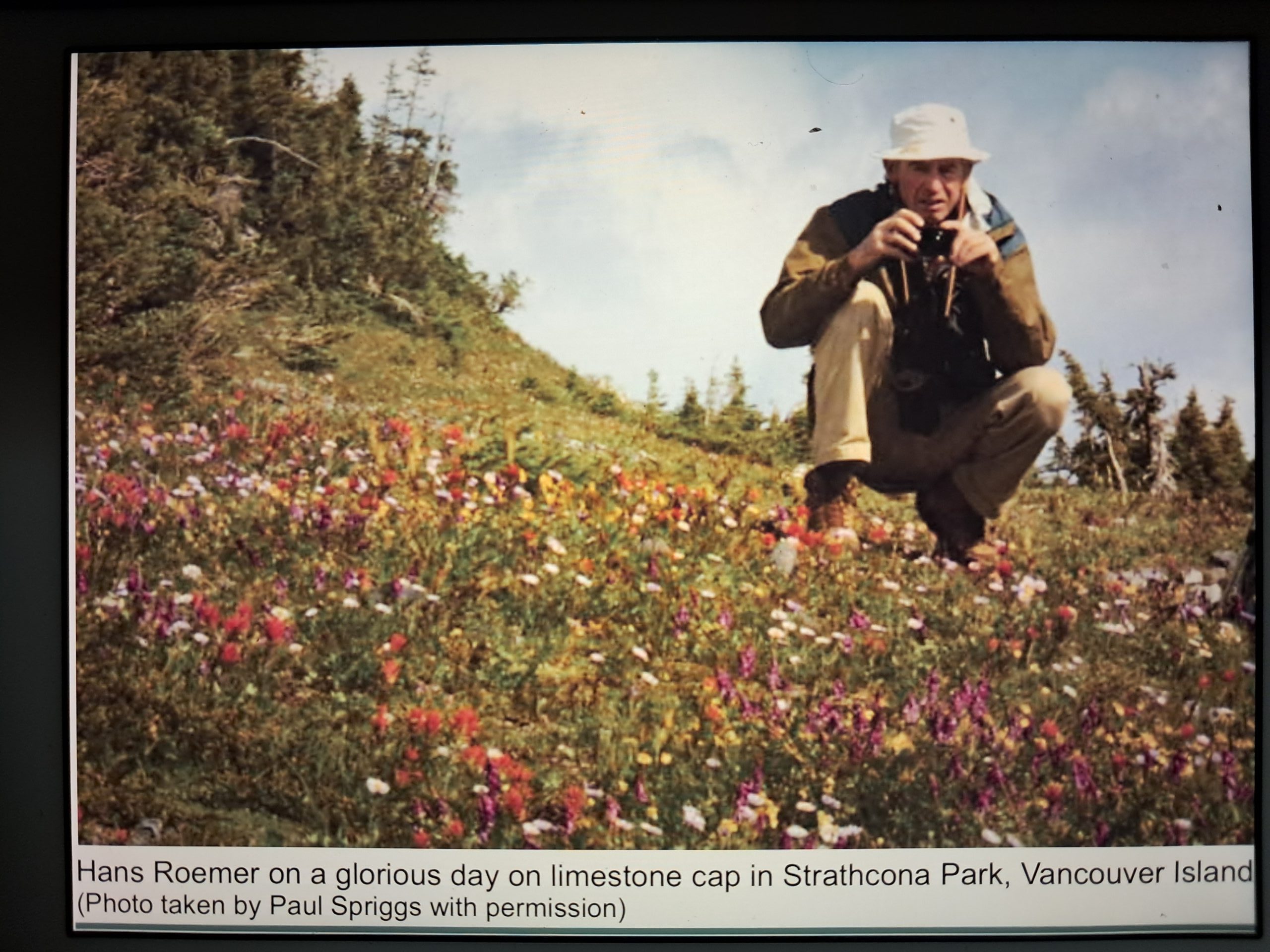
Saying Goodbye to Well-known Biologist Hans Roemer
Hans Ludwig Roemer April 25, 1938 – Feb 3, 2026
Hans has left us to explore the alpine meadows in heaven, correcting the misnamed plants and finding unknown species. Having spent his early years growing up in the shadows of the Alps, he was passionate about plants and mountains all his life.
In 1965, Hans’ life path was shaped by a mountaineering expedition to Afghanistan. In 1967 a call from Marc Bell in Canada offering work as a research assis- tant at the new University of Victoria changed his path again. He signed up for one year, but he never left Victoria.
Hans’ kind, generous, and adventurous spirit will be rememberedh by future generations of professionals, friends, and family who have benefited from his knowledge and mentorship over the years. In his life he published a native plant guide and was hon- oured to have a native grass named after him (Festuca roemeri). Hans leaves behind a legacy of research, stewardship, and leadership in protecting rare ecosystems… as well a special alpine rock garden.
He will be missed by his family: his wife Heidi, son Markus (Emily van Lidth de Jeude), daughter Julia (Keith Davies) and grandchil- dren Taliesin, Rhiannon and Evan, as well as his siblings in Germany and the family labradoodle Mädi.
The family wishes to thank Hans’ doctors and the compassion- ate and dedicated team of palliative and hospice care givers. Instead of flowers, please consider a donation to the Marc Bell Scholarship in Environmental Studies at UVic. https://extrweb.uvic.ca/donate/m arc-bell
Condolences may be offered to the family below at: McCall Gardens, www.mccallgardens.com.
(Thanks you to Hans’ family for permission to reprint his obituary.)
Summary of an Interview Conducted by FER President Mike Fenger in 2011
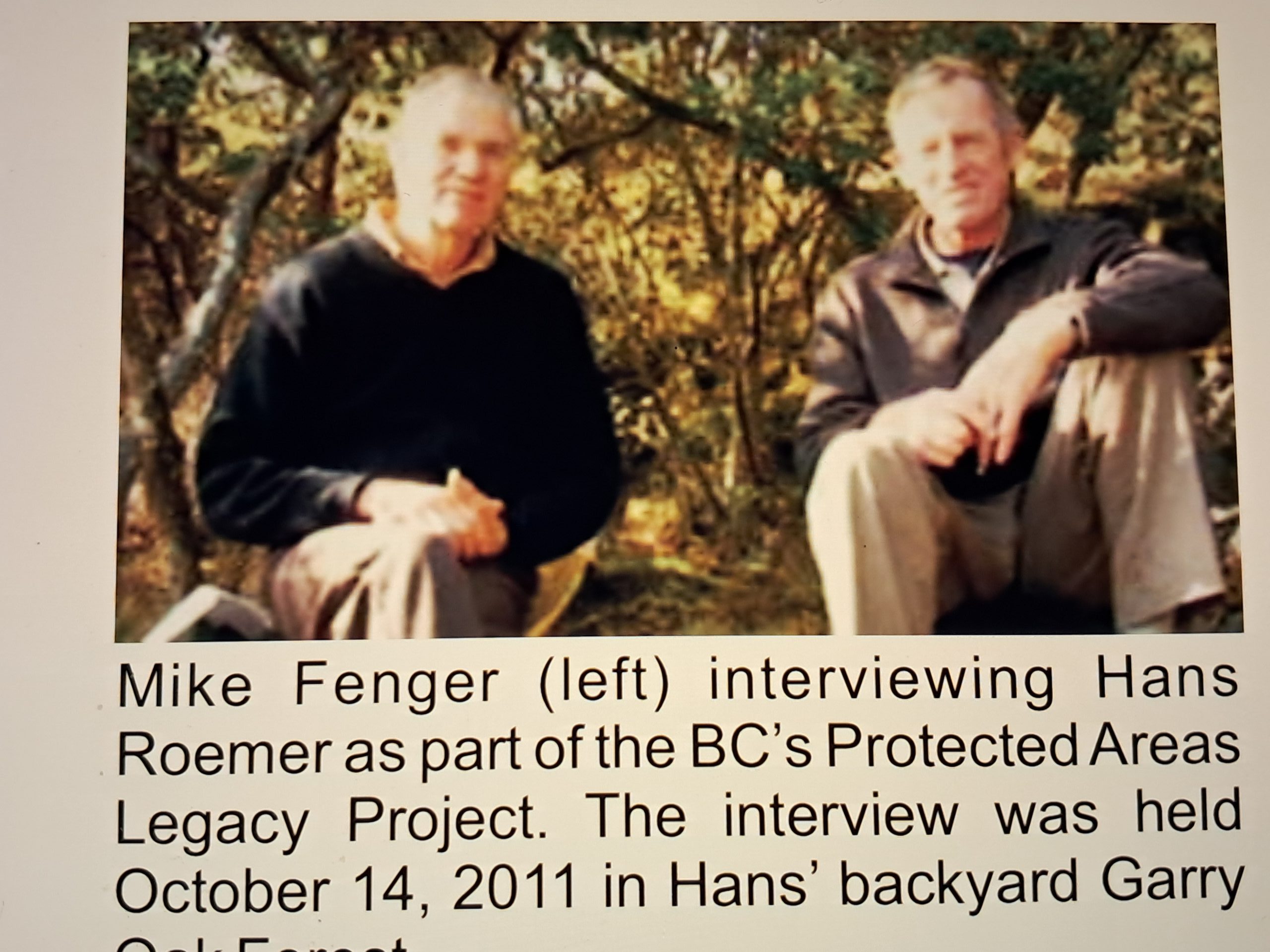
Hans Roemer became interested in ecology long before he came to Canada from Germany. He spent one year as a research assistant, before he started on a PhD at the University of Victoria. He worked in the natural environment in forest ecology and was interested in the Ecological Reserves program as well. Hans did his dissertation on forest ecosystems on the Saanich Peninsula. He attended the early meetings of the so-called “Reserves Committee” which included scientists, foresters and biologists from far and wide.
He was offered the Ecological Reserves job in 1978 which had been vacated by Dr. Jim Pojar. He became the ER ecologist. He surveyed potential ERs looking for pieces that would fit the puzzle. As Hans was a plant ecologist he was looking for original native pieces of forest that were undisturbed, especially those ecosystems that were already becoming uncommon at that time. The Coastal Douglas
Mike Fenger (left) interviewing Hans Roemer as part of the BC’s Protected Areas Legacy Project. The interview was held October 14, 2011 in Hans’ backyard Garry Oak Forest.
Fir zone is a prime example of an area that was logged heavily and only a few places remained. The process to advance the idea of an ecological reserve in this type of area was long and arduous and very often not approved.
When Hans was asked how many ERs were established when he began, he thought in the order of 100. Hans worked with Bristol Foster who was the ER Coordinator and Director of the ERs and with different temporary people like Trudy Chatwin (at that time Trudy Carson) and Lynne Milnes.
Remembering Hans Roemer Cont’d from p. 9
Hans travelled quite a bit and did manage to add some ERs in the eastern corner of BC. He wasn’t as successful with the northern part of B.C. Hans worked directly for the ER program for 17 years. When asked if he remembered an area that stood out and he recalled the following:
“I remember one time we were up in the McGregor River area and were surveying a transect that went from river flats through wetlands, up slopes to a mountain top. When we got up there we looked back down and there was a big grizzly bear with two cubs. The mother, presumably it was the mother, was teaching the two cubs how to catch ground squirrels. She would dig them out and let them go and the little ones would pounce on them and catch them again and so on. That was quite delightful. Many such adventures happened during work and I enjoyed them.
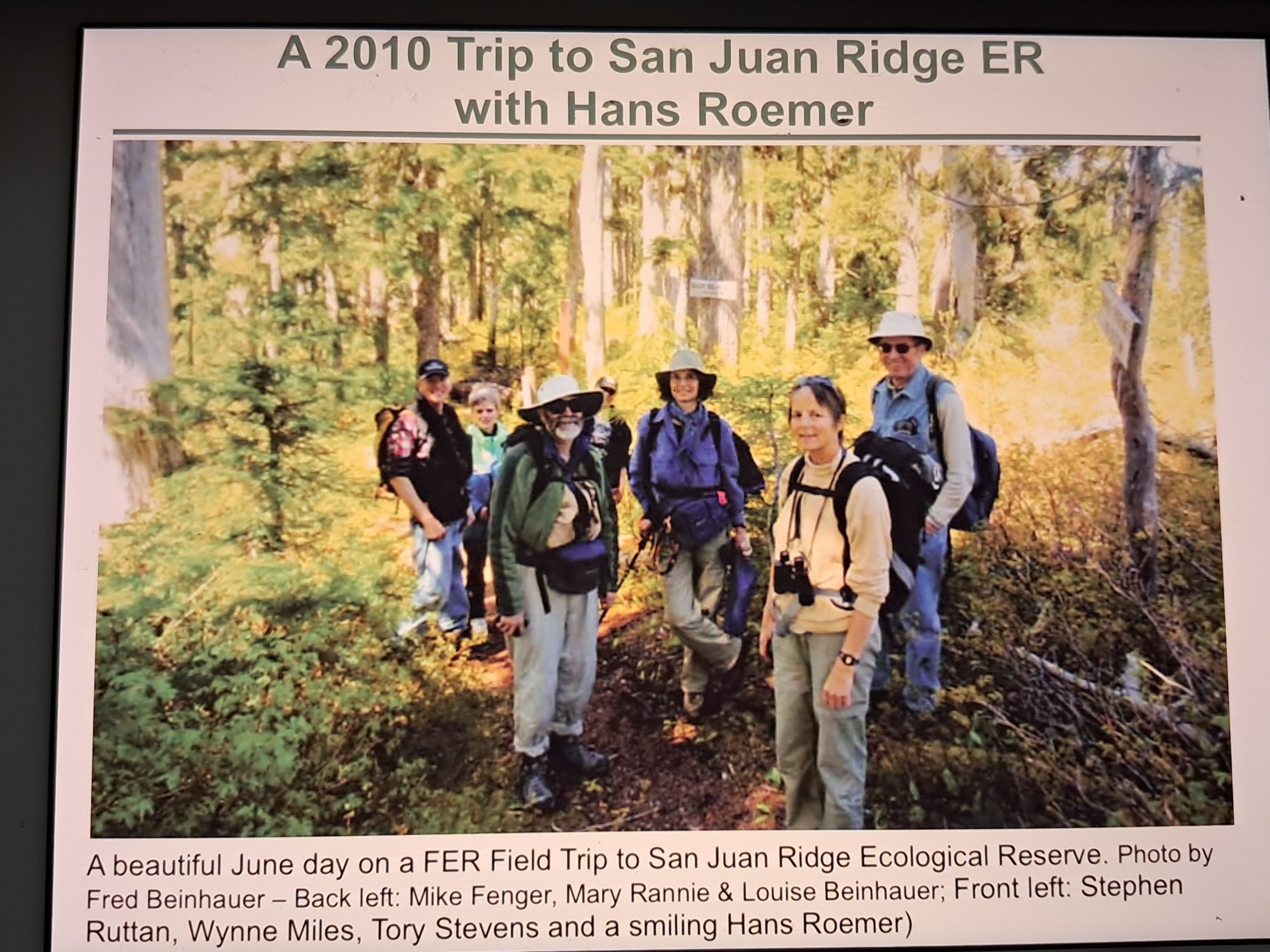
”On a balmy day in June, Friends of Ecological Reserves Board members Mike Fenger, Stephen Ruttan (trip organizer), Mary Rannie and Wynne Miles along with guests; our guide, biologist Hans Roemer, Ministry of Environment’s Tory Stevens, Fred Beinhauer and I car pooled along Highway 14 on our way to the San Juan Ridge Ecological Reserve.
About three kilometers west of Jordan River, our two-vehicle convoy turned off the highway and began an 18-kilometer upward trek on the Jordan River Mainline, an active logging road.
We stopped briefly on the way at a beautiful marshy area. After a short walk over boggy ground, Hans pointed out clusters of marsh- marigold (Caltha leptosepala) as well as subalpine daisy (Erigeron peregrinus), Western bog-laurel (Kalmia microphylla) and a plant that I found most fascinating, Round-leaved sundew (Drosera rotundibolia) that exudes drops of sticky fluid which ensnares insects that not only pollinate the plant but feed it as well!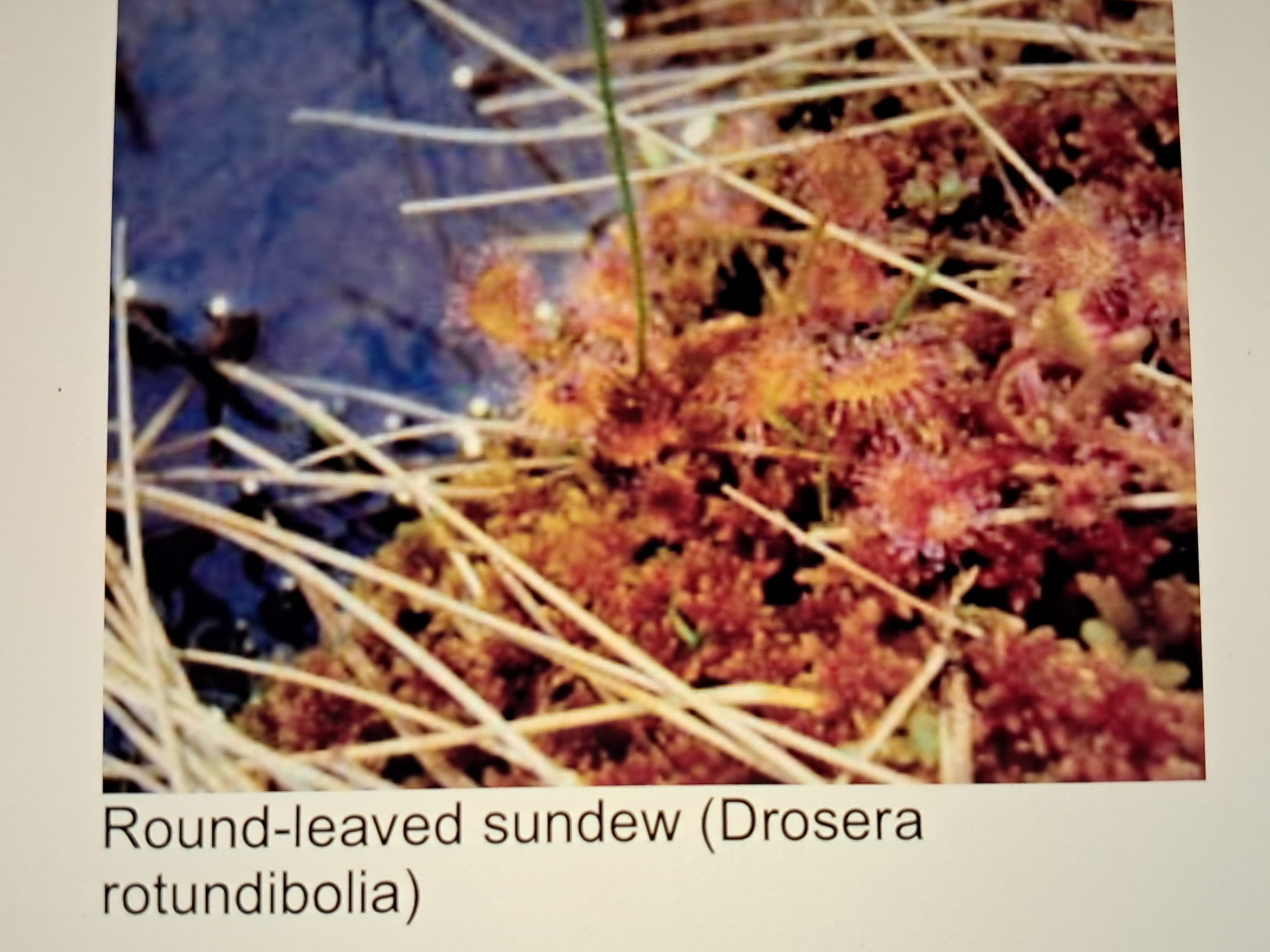
Then it was back into the vehicles to climb the rest of the way up the dirt road to an informal parking area. We hiked our way up the narrow road for another 400 metres or so and then turned north onto a small trail that took us to the Kludahk Trail. We were at an elevation of approximately 825 meters – subalpine!
The Kludahk trail runs east to west for approximately 48 kilometers along the spine of the San Juan Ridge and passes close by the Ecological Reserve. The trail is managed by the Kludahk Outdoors Club who were instrumental in its creation. This trail is snow bound
for almost seven months of the year, November to June and we hiked over many places with some snow still on the ground.
We travelled east along the trail for a few kilometers so that we could view the ER and admire another picturesque wetland area where tree frogs were chorusing. Hans knew every plant along the way – both their common and botanical names.
We decided to turn around and head west so that we could stop at one of the various huts along the trail. We were aiming for the Tea Hut, an interpretive centre with a wonderful view of the San Juan Valley far below.
Along the way to the hut, we saw hundreds of beautiful blue-listed avalanche lilies (Erythronium montanum). 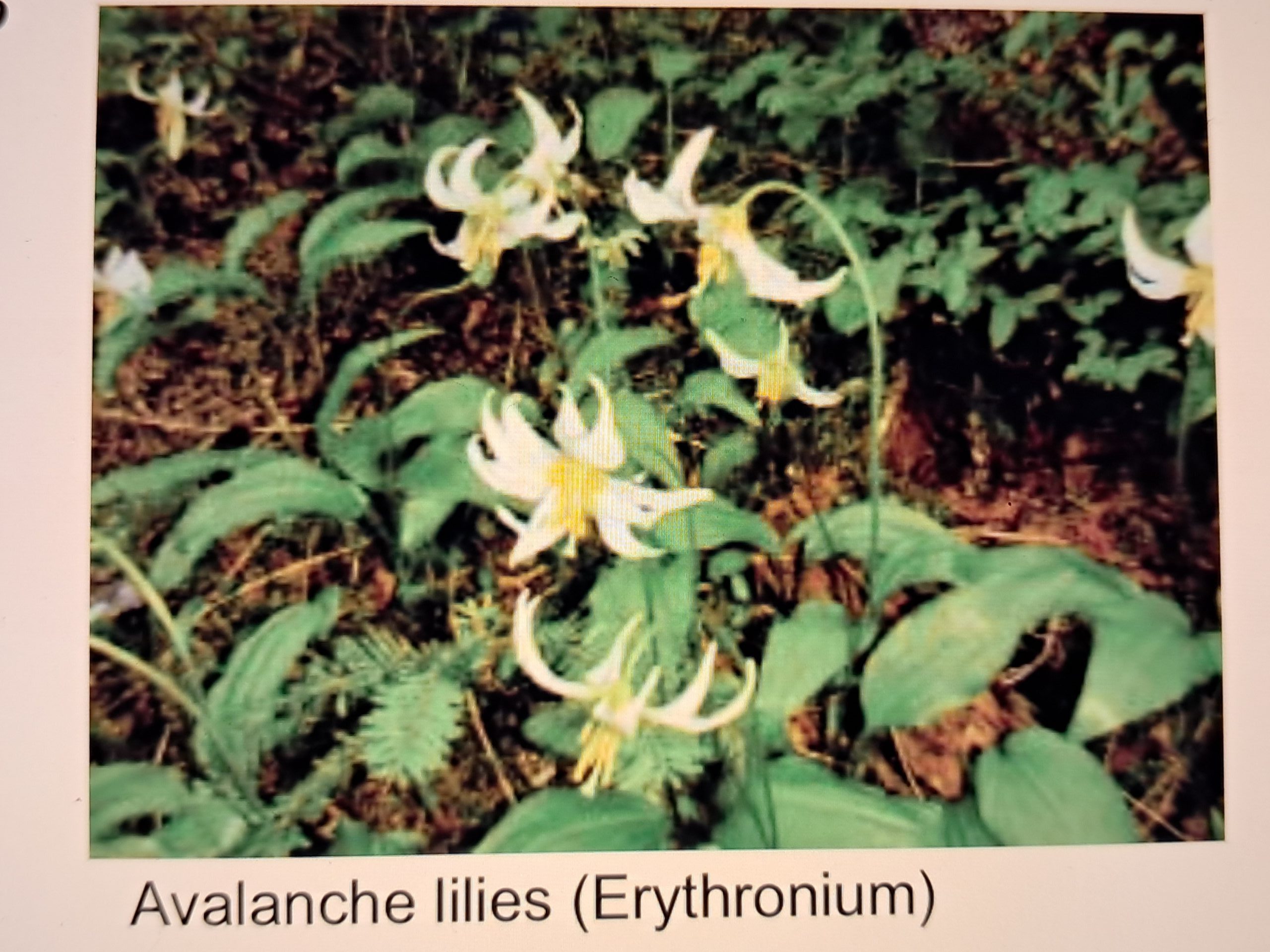 They were the reason for our trip as they are most spectacular in mid-June. They bloom as the snow is retreating.
We also stopped at several tranquil alpine lakes along the way. Every lake and most meadows were named; there was even one called the Hans Roemer Meadow.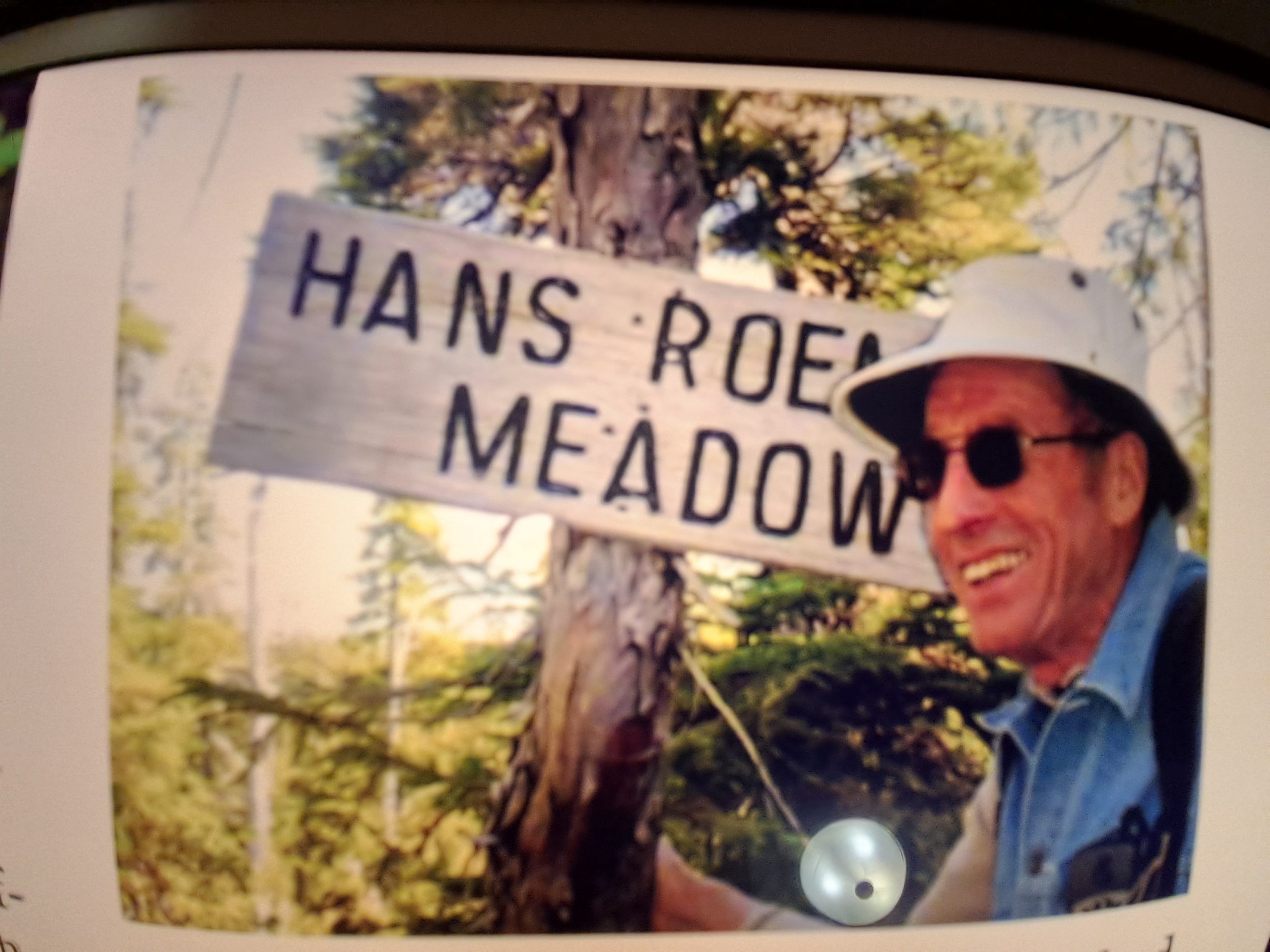
At one small lake, I made a half- hearted attempt to catch a Rough- skinned Newt in order to see the orange belly that Tory said they had which serves as a warning to would- be predators. Much to my surprise, I actually caught him and his belly was indeed bright orange. I carefully put him back into the water and we continued on our way.
We arrived at the Tea Hut and sat and ate our lunches, admiring the spectacular view and reading the information panels adorning the wall. All too soon it was time to return to our cars for the drive back to town.
This was the only time that I had met this knowledgeable, kind man. I was so impressed with his calm easy-going manner. His contribu- tions were many and he will be missed. I am grateful for his recent book which he wrote in collaboration with Mary Sanseverino called Native Plants of British Columbia’s Coastal Dry Belt.
See the pdf file here: Hans Roemer-remembrance-final