Categories:
Guest blog by Julia Carr, 2024 field team member with the BC Parks Biodiversity Program. Julia visited Ahlúu Ḵáahlii Vladimir J. Krajina (Port Chanal) Ecological Reserve on Haida Gwaii in late summer 2024. Haida place names provided by Raven Ryland, Communications Manager for the Council of the Haida Nation. Click here to listen to recordings of these names and to learn about Haida place name restoration.
Since 2019 the BC Biodiversity Program has employed teams of naturalists and researchers to conduct biodiversity surveys throughout the province, with a focus on protected areas including provincial parks, ecological reserves, and conservancies. Formerly called the BC Parks iNaturalist Project, this program uses the community science platform iNaturalist to document this province’s incredible biodiversity. This program also aims to promote community engagement with biodiversity through iNaturalist, which allows users to upload photos of living organisms for identification by a community of experts and amateur scientists. iNaturalist is a fantastic tool that makes it easy for anyone to contribute to broadening our understanding of B.C.’s biodiversity; see the BC Biodiversity Program’s website for guides on getting started, and visit the BC Parks project on iNaturalist to see what has been recorded in provincial protected areas. The BC Biodiversity Program is funded in part by the BC Parks License Plate Program.
A permit is required to access Vladimir J. Krajina Ecological Reserve. Permits are available for research and educational purposes only.
In August of 2024, the BC Parks Biodiversity Program field team was fortunate to spend three weeks on the beautiful islands of Haida Gwaii, conducting biodiversity surveys in protected areas. We did several day trips to different parks around Haida Gwaii, using community science tools like iNaturalist and eBird to log our sightings. We were constantly amazed at the biological diversity in these parks, especially in bryophytes (mosses, liverworts, and hornworts) and other bog plants. Undoubtedly, the most memorable experience was our trip to Ahlúu Ḵáahlii Vladimir J. Krajina (Port Chanal) Ecological Reserve, on the remote west coast of Haida Gwaii.
This ecological reserve is located on the middle west coast of Xaadáa Gwáayee xáa.uguusd | XaaydaGa Gwaay.yaay IinaGwaay Graham Island, and is a protected area over 9,700 hectares in size. Accessible by boat, float plane, or helicopter only, it comprises mountainous terrain (up to 825 m in elevation), 60 km of shoreline, two large islands, and a fjord with the name Ahlúu Ḵáahlii Port Chanal. The ecological reserve—currently named after botanist Dr. Vladimir Joseph Krajina—is in an area known by the ancestral Haida name Ahlúu Ḵáahlii. BC Parks staff are working with the Haida Nation on a project to restore this and other ancestral names of protected areas and ecological reserves on Haida Gwaii.
On the first morning, we caught the ferry from HlGaagilda Skidegate to Gaats’iiGundaay Alliford Bay, making our way to the K’il Kun Sandspit airport to meet our helicopter pilot. There, we met up with Nicole Day from the Heritage & Natural Resources department of the Council of the Haida Nation, who joined us on the trip. Nicole would be conducting plant surveys and recording signs of human habitation, such as culturally modified trees (CMTs). Upon arrival, unfortunately we discovered that the helicopter did not have enough room for all five of us and our gear, no matter how hard we tried to condense it. One of us would have to stay behind. So, I said a tearful goodbye and watched them ascend in the helicopter. Oh well, I thought – at least I’ll have our accommodations to myself for a whole week!
Or so I thought. Thirty minutes after departure, I got a text from a team member: “Don’t board the ferry! We’re coming back!!”. Despite it being a mild and relatively clear day in K’il Kun, as they got closer to the west coast, the pilot determined it was too socked in to safely descend into the reserve (a common story on the wild west coast of the islands). With the help of our project manager Arianne back in Vancouver, we came up with a contingency plan: we would charter a boat from Massett on north Xaadáa Gwáayee xáa.uguusd | XaaydaGa Gwaay.yaay, travelling some 150 kilometres around the northwestern tip of Haida Gwaii and down the west coast. It was a big change from our original plan, but we were just glad to have another way to get to the ecological reserve.
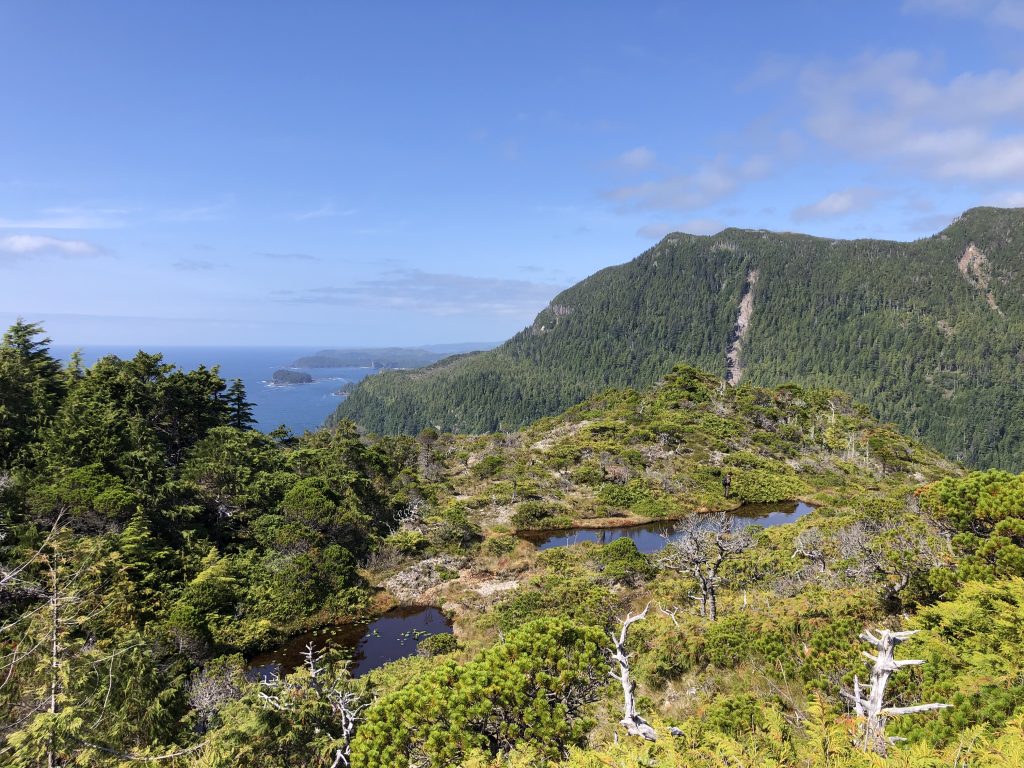
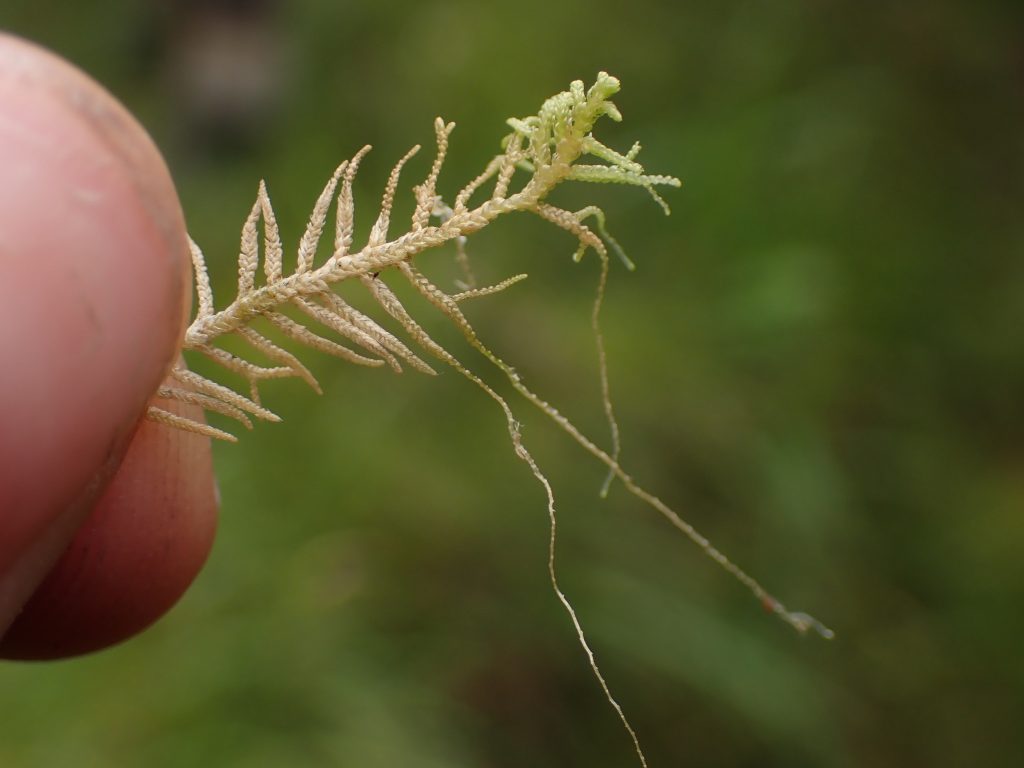
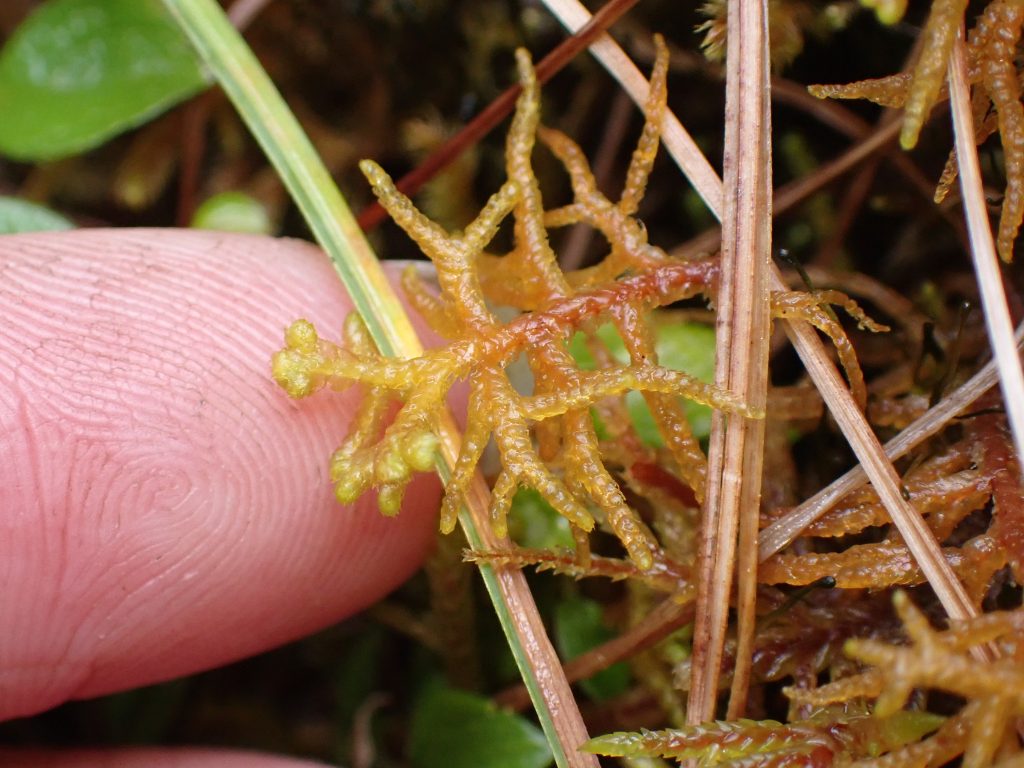
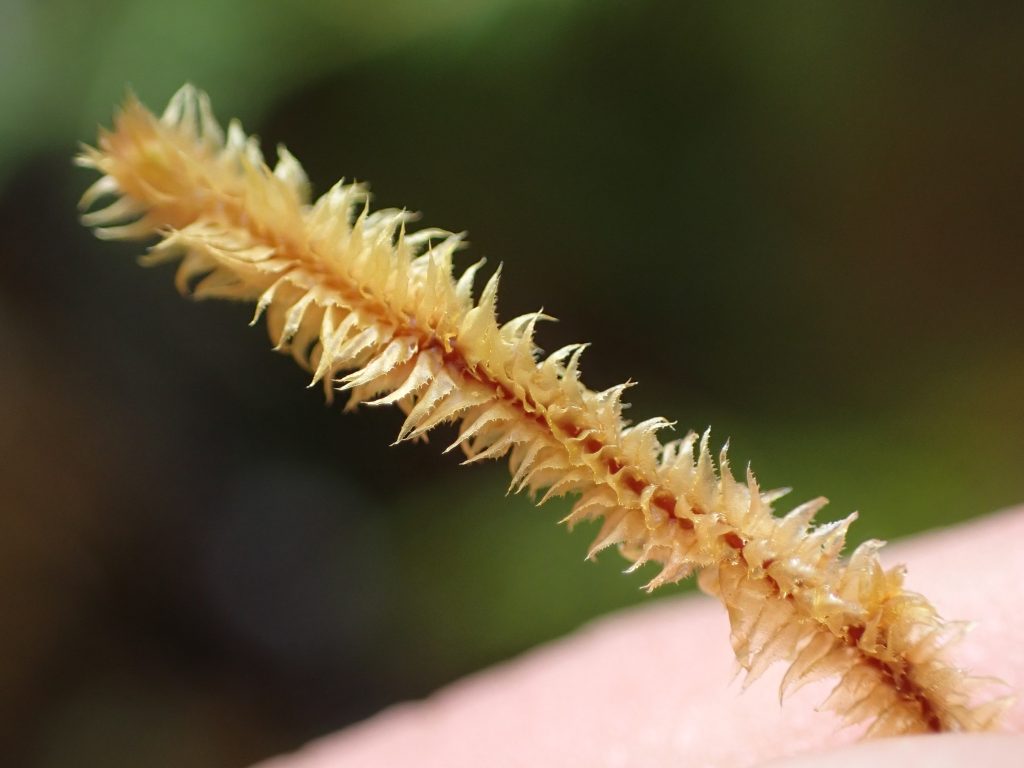
The boat ride was very fun, very wet, very bumpy, and very rewarding: we got to see some of Haida Gwaii’s beautiful outer coastline, as well as a tufted puffin, an albatross, and many other seabirds. Upon arrival in the ecological reserve, we set up base camp in an idyllic mossy grove not far from the shore and began exploring around our camp. On our first full day, we ventured up to the nearest high point, hiking through Sitka spruce forests and Haida Gwaii’s beautiful bog ecosystems. We found many interesting bryophytes (the group that includes mosses, liverworts, and hornworts), including Lepidozia filamentosa, a liverwort with long filamentous strands found in the very wet forests along the coast, and Wood’s whipwort (Mastigophora woodsii), a B.C. red-listed (provincially endangered or threatened and at risk of being lost) liverwort with records in the UK and Ireland, the Himalayas, and Mexico. Another standout was Plicanthus hirtellus, a blue-listed (provincially of special conservation concern) liverwort growing in the mossy mats of the high elevation bogs. We also found some cool vascular plants, including the Haida Gwaii endemic (found only on Haida Gwaii in the whole world) Newcombe’s butterweed (Tephroseris newcombei), and broad-petalled gentian (Gentiana platypetala).
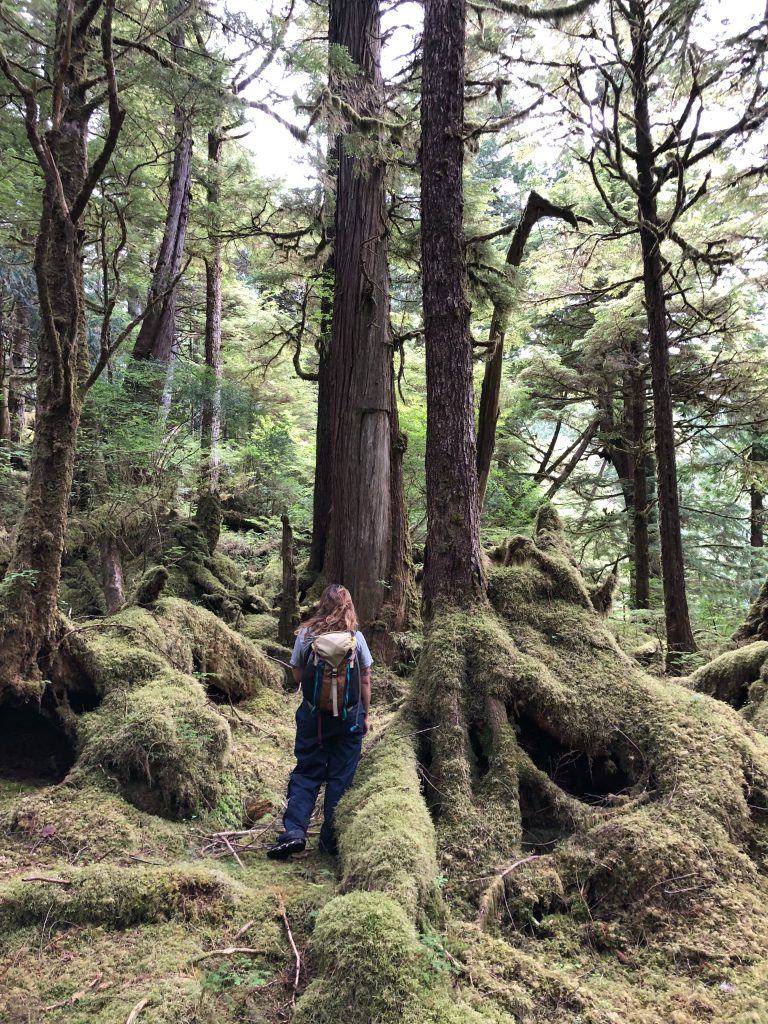
That evening, we got some unfortunate news: the weather was turning, and the boat would need to pick us up the following afternoon. We made the most of the next morning, hiking through another bog forest and along the river to a nearby lake, where we saw river otters, belted kingfishers, and American dippers. On the way back, we came across an ancient trail through giant old growth cedar and spruce, and numerous culturally modified trees – illustrating the extent to which the Haida inhabited and made use of their territory. It was a beautiful ending to our trip.
We are grateful to the Haida for their hospitality and their stewardship of Haida Gwaii since time immemorial. If you plan to visit Haida Gwaii, please take a look at the Haida Gwaii Pledge